
As the nation marks the 250th anniversary of the American Revolution, O250 brings the commemoration home by highlighting the people, places, and events that connect Ossining to this history. REVOLUTIONARIES AT REST is part of that effort to preserve and share our local Revolutionary legacy.
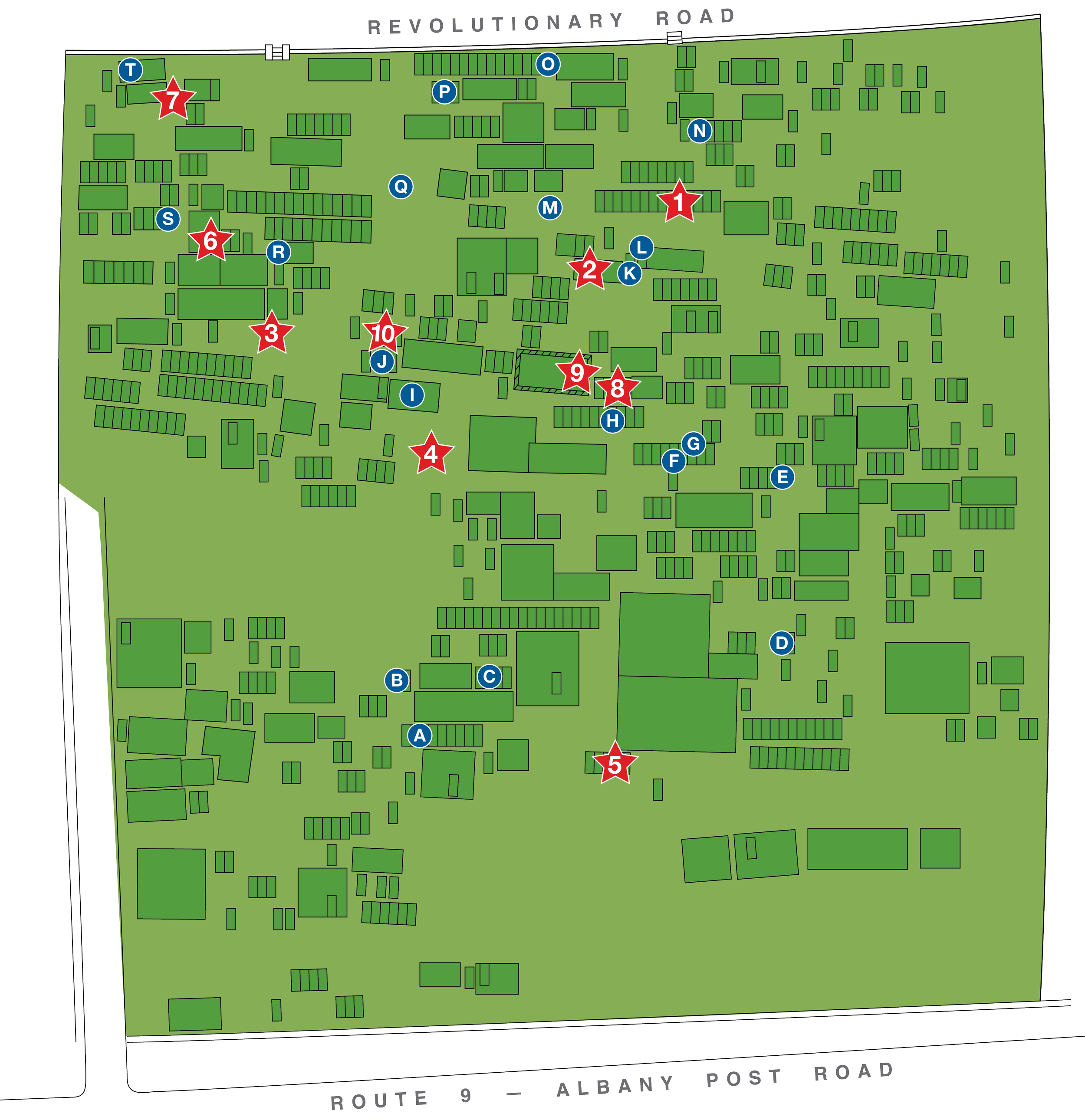
The following biographies were written by Caroline Ranald Curvan, Town of Ossining Historian and Joyce Sharrock Cole, Village of Ossining Historian. The map below is Sparta Cemetery.

FOOTNOTES:
New York State Comptroller’s Office, New York in the Revolution as Colony and State (Albany: J.B. Lyon Co., 1904), 213, Internet Archive, archive.org/details/newyorkrevolution01statrich/page/213. (Accessed September 14, 2026)
New York State Comptroller’s Office, New York in the Revolution as Colony and State (J.B. Lyon Co., 1904), 213, Internet Archive, archive.org/details/newyorkrevolution01statrich/page/213. (Accessed September 14, 2026).
1) moses Ward (1753 - 1812)
Private, Third Regiment, Westchester County Militia
Moses Ward was born in 1752 as a British subject on Loyalist Frederick Phillipse III’s manor to tenant farmers Thomas Ward and Freelove Pinckney. In 1771, he married Ann Sherwood, daughter of Job Sherwood (also buried in Sparta cemetery) and niece of Col. Samuel Drake, beginning a family that would eventually include seven children, including a future General and US Congressman.
When the Revolutionary War broke out, Ward immediately joined his uncle-in-law Col. Samuel Drake’s Third Regiment.[1] This Regiment was tasked with the grueling duty of patrolling the so-called “Neutral Ground,” that lawless and dangerous area between British-occupied New York City and the American-held Hudson Highlands.
The 3rd Regiment faced constant threats not only from Loyalist (British) forces but also from predatory bands of thieves (both later dubbed the “Cowboys and Skinners” by James Fenimore Cooper in his 1821 novel The Spy: A Tale of the Neutral Ground. Cooper is also believed to have coined the term “Neutral Ground.”)
While we don’t have specific information about how long or where Ward served during the Revolution, it likely involved coordinating local defense in the Upper Phillipsburgh area (today’s Ossining.) As a young man – he would have been about 22 when he joined up - he would likely have been on the front lines gathering intelligence and responding with musket and ball to frequent British raids aimed at seizing livestock and supplies.
Ward’s contributions during these skirmishes helped protect local farms and maintain a semblance of order in a region ravaged by conflict. His service was not just a matter of military duty in the cause of independence, but also for the immediate survival of his community.
Following the war, Moses and Ann Ward were important members of the post-war reconstruction of the village. In 1785, Ward was able to purchase the manor farm he had tenanted - 181 prime acres including riverfront land from the Commissioners of Forfeiture in what is now the center of the Village of Ossining. His son, Aaron Ward, would go on to serve in the War of 1812, rising to the rank of Major General in the New York Militia. He would also become a lawyer, a five-term U.S. Congressman, and build an elegant mansion called Careswell on what is now the site of the Ossining High School.
Moses Ward died on December 3, 1812, at the age of 59. His headstone stands as a testament to a man who risked his life for the birth of a new nation and the protection of his home.—CRC
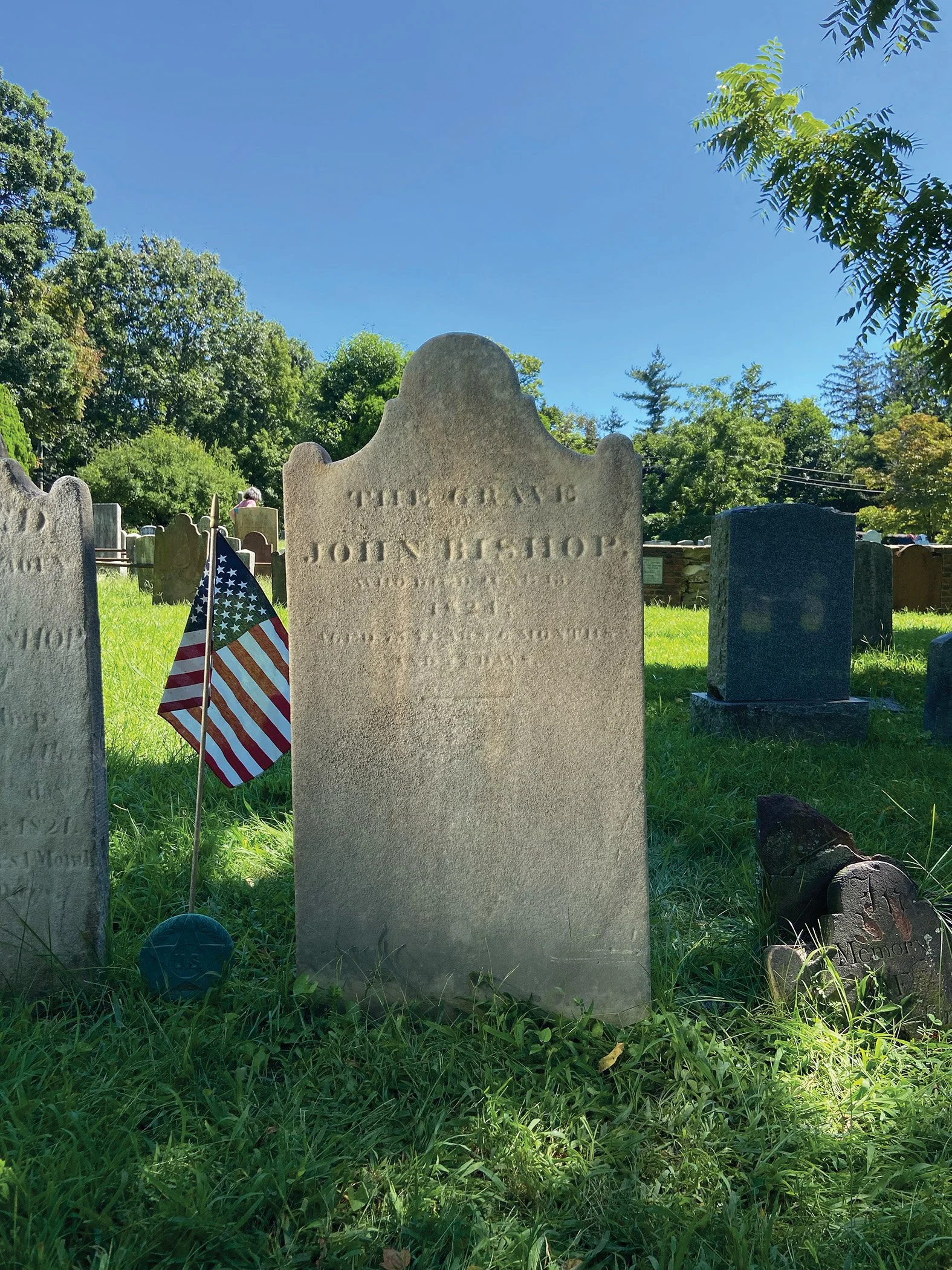
2) john Bishop (c. 1748 – 1824)
Private, First Regiment, Westchester County Militia
John Bishop’s story is representative of the "everyman" soldier of the American Revolution—the local farmer who took up arms to defend his land and his neighbors. Born a British subject to a tenant farmer on Phillipsburgh Manor, Bishop lived in Westchester during a time when the region was one of the most contested territories in the colonies.
Bishop served as a private in the 1st Regiment of the Westchester County Militia. Under the command of Colonel James Hammond[1], this unit was the primary defense for the area around today’s Ossining. The service of a militiaman in Westchester County was one of constant vigilance. Unlike the Continental Army, which often moved across state lines, the militia generally remained local, meaning that Bishop would often find himself fighting within a few miles of his own home.
The "Neutral Ground" where Bishop served was a landscape of fear. British and Hessian soldiers from New York City frequently pushed north to forage and intimidate the populace, while Loyalists marauders (sometimes erroneously referred to as “Cowboys”) conducted brutal raids. Bishop and his fellow militiamen were the only line of defense against these incursions. Their duties included patrolling the Albany Post Road, responding to attacks and engaging in hit-and-run skirmishes that prevented the British from establishing a permanent foothold north of the Croton River.
After the war ended in 1783 with the Treaty of Paris, Bishop returned to his life as a farmer purchased 83 acres of prime riverfront land from the Commissioners of Forfeiture for £249 – located just to the west of Col. Samuel Drake’s land and to the north of Moses Ward’s farm. He would marry Sarah Merrit in 1788.
The Bishops were active members of the growing community in Sing Sing. The transition from soldier to civilian was a common but difficult path for many veterans, especially in an area as destroyed as Westchester. However, they made the best of things and flourished.
John Bishop passed away in 1824, at the age of 76. His will, probated in Westchester county, indicated that he was a fairly wealthy man for that time and place. He bequeathed the majority of his estate to his son Jesse Bishop, which included not only all his land, but also “shoe buckles, my watch, silver tablespoons, knee buckles and gold sleeve buttons.” He would leave $1500 to his daughter Phebe Landrine, as well as “all my silver teaspoons, bedstead, bed, bolster, two pillows and bedding.”[2]
His burial in Sparta Cemetery, alongside many of his former comrades-in-arms and neighbors reflects the quiet, enduring bravery of deeply connected local militia who held the line during the nation's darkest hours and went on to rebuild a community devastated by seven years of war. —CRC
FOOTNOTES:
Sometimes spelled “Hamman”
Will of John Bishop, [Westchester, NY, 1824], New York, U.S., Wills and Probate Records, 1659-1999, https://www.ancestry.com/imageviewer/collections/8800/images/005514110_00357?usePUB=true&usePUBJs=true&pId=12559463. (Accessed September 14, 2026)
FOOTNOTES:
Martha Mesiti (former Ossining Town Historian) in email with author August 21, 2026
"Richard Garrison," Compiled Military Service Record, U.S., Compiled Revolutionary War Military Service Records, 1775–1783, National Archives and Records Administration, Ancestry.com (https://www.ancestry.com/imageviewer/collections/1309/images/MIUSA1775C\_116781-01296?usePUB=true&usePUBJs=true&pId=222254 : accessed September 14, 2026).
“Garrison/Gerretsen Family Tree,” n.d., Ossining Historical Society and Museum, Ossining, NY
“Garrison/Gerretsen Family Tree,” n.d., Ossining Historical Society and Museum, Ossining, NY
3) Lt. Nathaniel garrison (b. 1737 – d.?)
Lieutenant, First Regiment, Westchester County Militia
The history of the American Revolution in Westchester County is often told through the lens of the "Neutral Ground"—a twenty-mile-wide strip of land between British-occupied Manhattan and the American lines to the north. It was a lawless territory where survival required both physical grit and unwavering conviction. Nathaniel Garrison, born in 1737, was a man who possessed both, serving as a Lieutenant in the First Regiment of the Westchester County Militia under the command of his Uncle, Colonel James Hammond.
Nathaniel’s military service was defined by the unique challenges of Westchester County. Rural and lightly populated, the militia under Colonel Hammond consisted of local farmers and tradesmen. Unlike the those who served on the Continental Line and who could be called out of state for months at a time to fight, the militia were constantly on call to protect their neighbors from the plundering of the British and Hessian soldiers. As a Lieutenant, Nathaniel would have been responsible for leading these men during sudden alarms, guarding the Hudson River shoreline, and maintaining order in a region where loyalties were often divided.
His service was a family affair; his brother, Richard Garrison, served as the regiment’s Quartermaster, ensuring that the unit remained supplied in a county increasing stripped of its resources.
In 1772, Nathaniel married Tamer Requa. The Requa family were French Huguenots who had settled in the Philipsburgh Manor area and became staunch supporters of the patriot cause. A Requa farm bordered the Marvel Garrison farm, so it’s likely that Nathaniel and Tamer were neighbors.
A significant challenge for historians and genealogists is the presence of four men named Nathaniel Garrison in the same region. Here is what we know:[1]
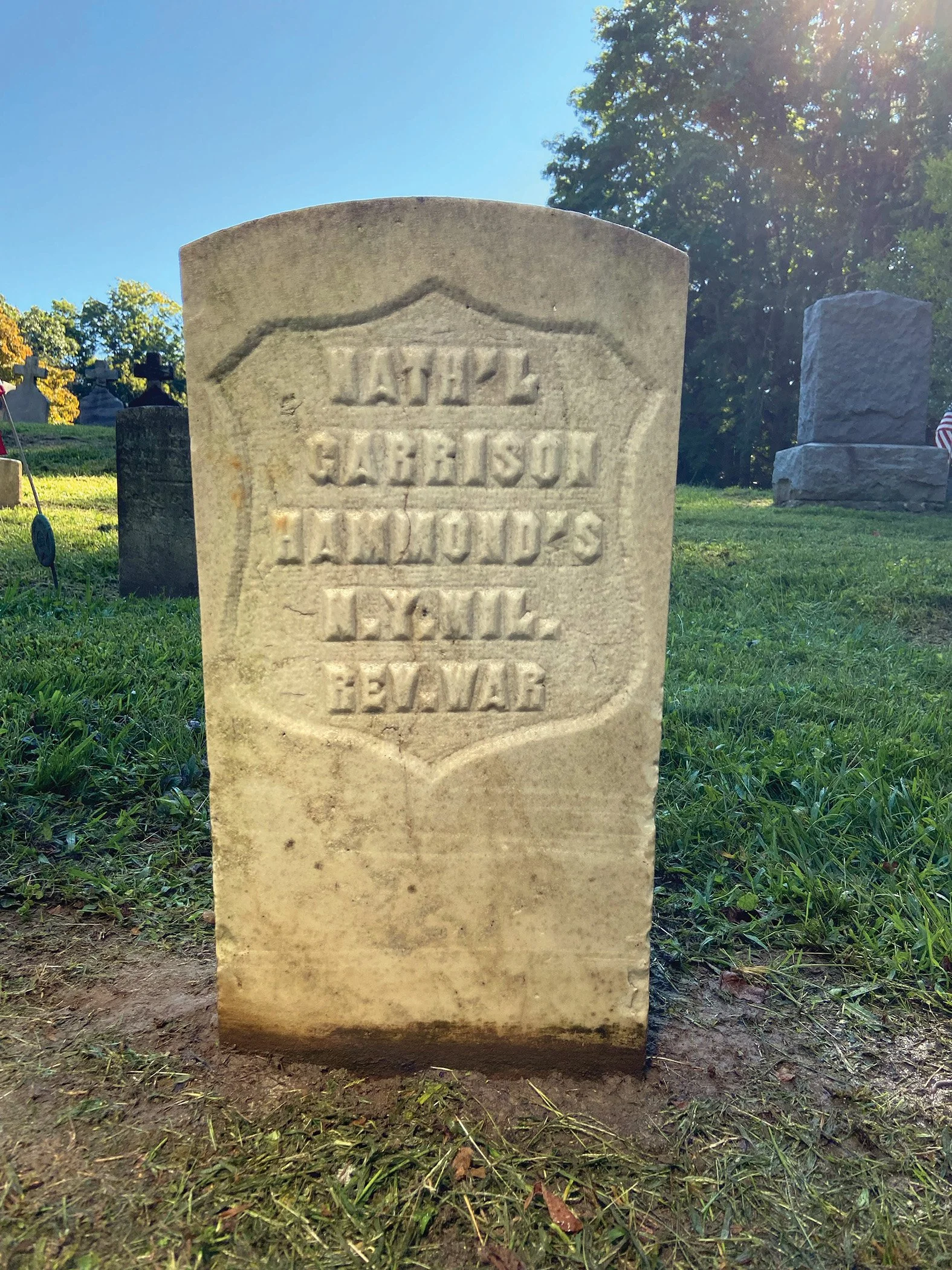
Marvel and Amy Garrison had a son named Nathaniel, b. 1737 — our Revolutionary War Lieutenant for whom the small marker noting his rank and affiliation with "Hammond’s NY MIL" stands in Sparta Cemetery. This Nathaniel had a son also named Nathaniel (1751 – 1841) although this son is not buried in Sparta Cemetery.
Lt. Nathaniel Garrison had a brother Richard (1742 – 1814) who also had a son named Nathaniel (1767 – 1843). This Nathaniel married Annis, and both are buried in Sparta Cemetery. This is the original Nathaniel headstone that stands today. These are the Garrisons that purchased Jug Tavern — the family would live there for much of the 19th century.
Brother Richard Garrison, the quartermaster, served with his brother in Col. Hammond’s 1st Regiment. Pension records indicate that he served for at least one year, from 1779 – 1780, receiving a disability pension for a “wound in his right side in his chest, age 41 years.”[2] In 1785, Richard Garrison would purchase 123 acres of land from the Commissioners of Forfeiture, marry Lea Aertse (Orser)[3] then Margaret, who survived him and lived until 1827. The family’s military tradition did not end with the Revolution; of his four children, his son Tallman Garrison would serve during the War of 1812.[4] Unfortunately, Richard Garrison’s stone has been missing from the cemetery for over 100 years, but old cemetery lists seem to indicate that he was buried there.
Perhaps further research will confirm the exact location of Lt. Nathaniel Garrison and his brother Richard’s graves. However, he and his brother remain powerful examples of the sacrifice and dedication to the patriot cause found in our area. —CRC
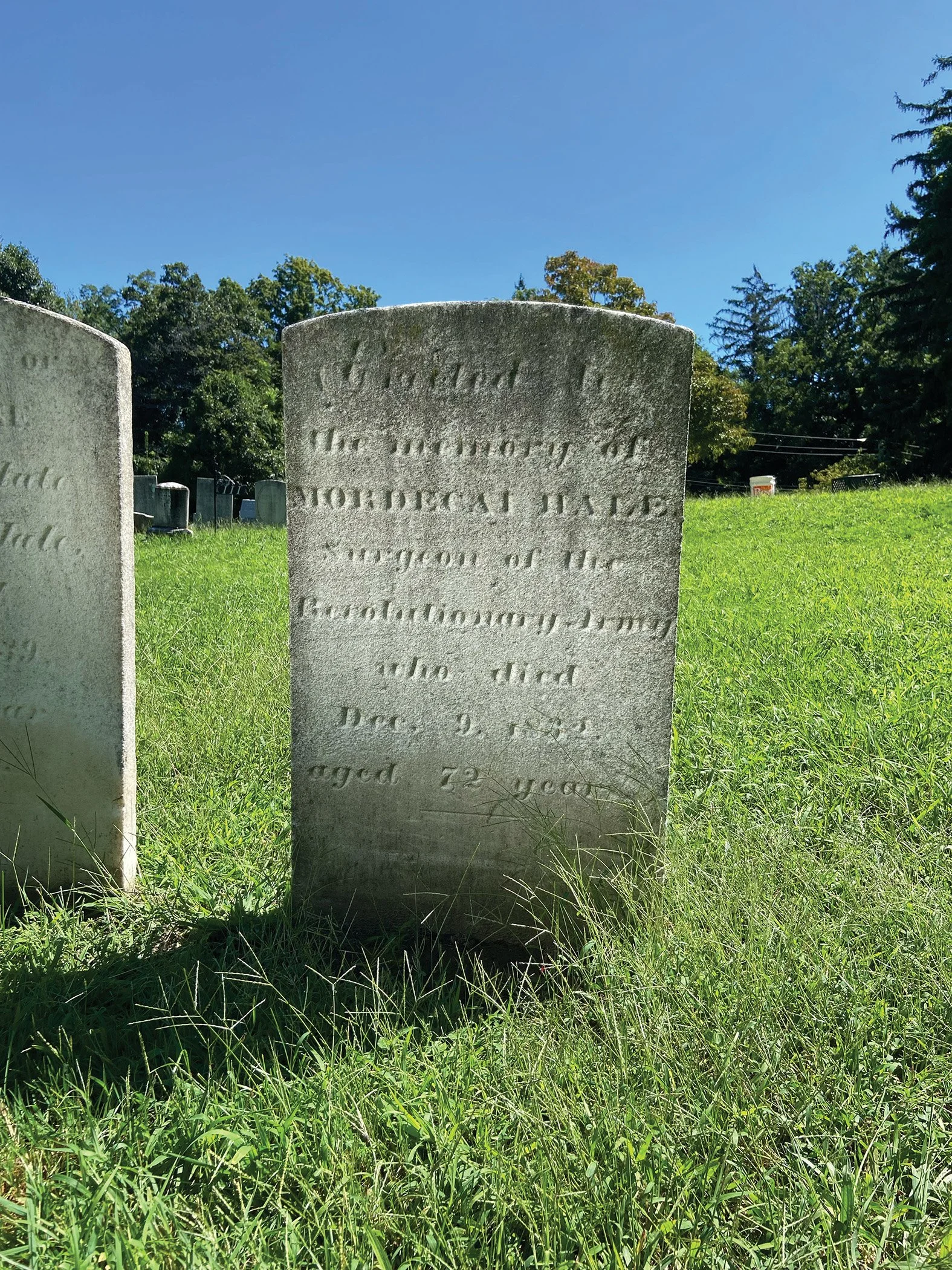
4) Mordecai HAle (1762 – 1832)
Surgeon's Mate, 2nd Continental Artillery Regiment
Mordecai Hale was born in Brookfield, Massachusetts in 1762, one of thirteen children of Captain Thomas Hale and Mary Kimball Hale. At eighteen, he joined Colonel John Lamb's 2nd Regiment of the Continental Artillery in New York State and was stationed at West Point. Hale may have even been there during Benedict Arnold's treasonous acts of September 1780.
We don’t know what, if any, medical training Hale had, but as a Surgeon's Mate, he would have been tasked with triaging wounded soldiers, providing battlefield care and assisting with war hospital surgeries.
In the summer of 1781, he marched with his regiment to Yorktown, Virginia, where he participated in the decisive battle that ended with British General Cornwallis's surrender on October 17, 1781, effectively ending the Revolution. (However, it took until September 3, 1783 for the war to end officially with the signing of the Treaty of Paris.)
In 1782, Hale suffered a severe horseback riding accident that caused "a hernia and rupture in the lower part of his belly and private parts by means of the starting of his horse"—leaving him, as the records state, "rendered incapable in a great measure of obtaining his livelihood."[1] In 1786, he was awarded a disability pension of $480 per year and four years later received a 600-acre land bounty in Camillus, New York.
Hale recovered well enough to marry Catherine Paulding in 1787, and together they had at least four children. This marriage connected him to some extremely important people: Catherine's father, General William Paulding, had been a Member of the Provincial Congress and then Commissary-General of the Militia during the Revolutionary War. Her sister Julia married author Washington Irving's older brother, William Irving, a three-term U.S. Representative. Catherine’s brother, James Kirke Paulding, was a writer and Secretary of the Navy from 1838 to 1841. Finally, Catherine's cousin, John Paulding, had helped capture British Major John André in Tarrytown in 1780.
Hale went on to serve a term in the New York State Assembly and then served as a surgeon in the U.S. Army, serving in Plattsburgh and later at Fort Lafayette in New York Harbor. He left military service in 1825 to open a private practice in Tarrytown. He died at his son's home in Sing Sing and was buried in Sparta Cemetery. His widow Catherine continued to receive his Revolutionary War pension until her own death in 1839.[2] —CRC
FOOTNOTES:
Affidavit, May 25, 1787, in Hale Pension File, Revolutionary War Pension and Bounty-Land Warrant Application Files, Record Group 15, National Archives, accessed via Fold3 or National Archives, https://www.archives.gov [or relevant URL] (accessed September 14, 2026).
"Mordecai Hale," Compiled Military Service Record, U.S., Compiled Revolutionary War Military Service Records, 1775–1783, National Archives and Records Administration, Ancestry.com (https://www.ancestry.com/imageviewer/collections/1995/images/MIUSA1775D\_135737-00732?queryId=26ef7ae2-de3b-4974-938d-d181149e499c&usePUB=true&\_phsrc=OKR1&\_phstart=successSource&pId=25901 : accessed September 14, 2026).
FOOTNOTES:
“The Week That Won the War: The Story of the Firing on the Vulture” by Char Weigl. The Westchester Historian, vol. 101, Number 4, Fall 2025
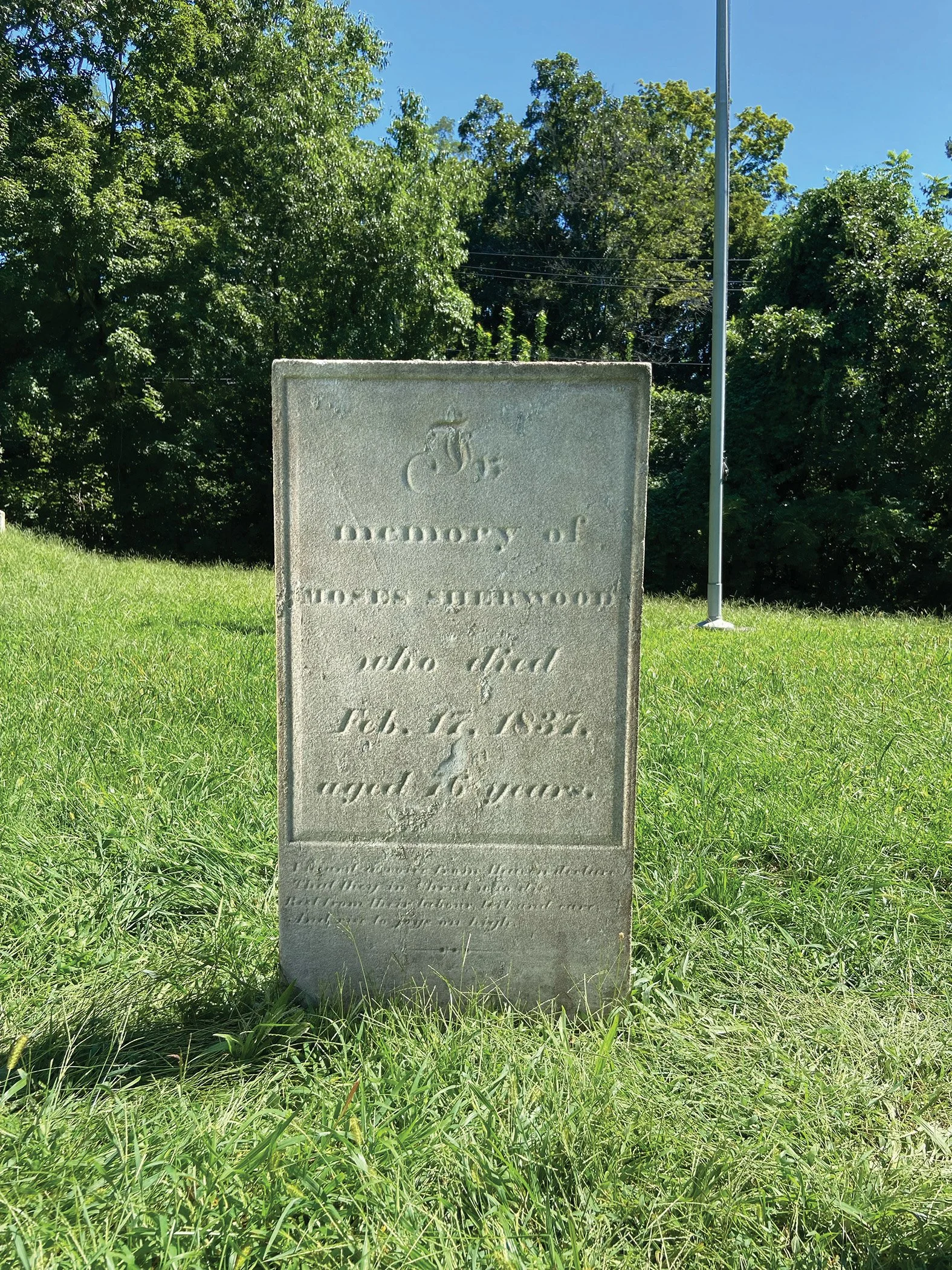
5) moses Sherwood (1762 – 1873)
Private, First Regiment, Westchester County Militia
The story of Moses Sherwood is a fascinating study in how local lore, national history, and genealogical truth intertwine. Born on Philipsburgh Manor to tenant farmers Gershom Sherwood and Margaret Orser in 1762, Moses was a private in the Westchester County Militia 1st Regiment, serving under Colonel James Hammond. (He served with his father Gershom, a lieutenant in the regiment, and his uncle Job who was a private.)
While the stories of many militiamen fade from history, Sherwood’s name became synonymous with one of the most pivotal moments of the American Revolution: Benedict Arnold’s treason and the HMS Vulture episode.
According to the traditional narrative, the drama began on September 21, 1780. Sherwood and John "Rifle Jack" Peterson were at Teller’s Point (now known as Croton Point), engaged in the very colonial task of making cider. Their work was interrupted when they spotted the HMS Vulture, a British sloop-of-war, in the Hudson River. The stakes were higher than they knew; the ship was there to facilitate General Benedict Arnold’s treasonous exchange of the plans to West Point with British spy Major John André.
The legend says that Sherwood and Peterson first opened fire on a barge full of British soldiers attempting to land. Realizing they needed more than rifles to deter a warship, the two men reportedly rushed to Verplanck to secure a four-pound cannon from Colonel James Livingston. Returning to the Point, they shelled the Vulture at dawn the next day. The barrage was effective enough to force the ship to move downstream for safety.
This proved catastrophic for Major André, who found himself stranded on the Haverstraw side of the river. Stuffing the plans to West Point in his boots, André was forced to make a perilous overland journey through Westchester in disguise. It was during this trek that André was captured in Tarrytown, leading to the discovery of Arnold’s treasonous plot to surrender West Point.
Eventually, a memorial plaque was placed at Croton Point Park to commemorate the bravery of Peterson and Sherwood. Interestingly, the plaque contains a notable error, mistakenly identifying the hero as "George" rather than Moses Sherwood—a reminder of how easily details can blur over centuries.
It’s a great story but, alas, recent research has called its veracity into question.
While the story of the shelling is a staple of local history books, scholars have found a lack of contemporary evidence to prove that Sherwood and Peterson actually shelled the Vulture or were the direct cause of André’s stranding. The most reliable evidence comes from John Peterson’s own testimony provided during the probate of Moses Sherwood’s will. This testimony seems to confirm that both men were indeed involved in firing at a British barge attempting to land at Croton Point, but never mentions the dramatic cannonade that supposedly changed the course of the war.[1]
Despite this debunking, Moses Sherwood remains a significant figure in Westchester. Following the war, he settled into a long life in the community he helped defend. In 1783, he married Apolina Rosenkranz, and together they raised approximately eight children. Sherwood lived to see the young nation grow, eventually passing away in 1837 after a prolonged illness. His life serves as a sobering example of how history is constructed—a blend of documented evidence and the powerful, enduring reach of a good story. —CRC
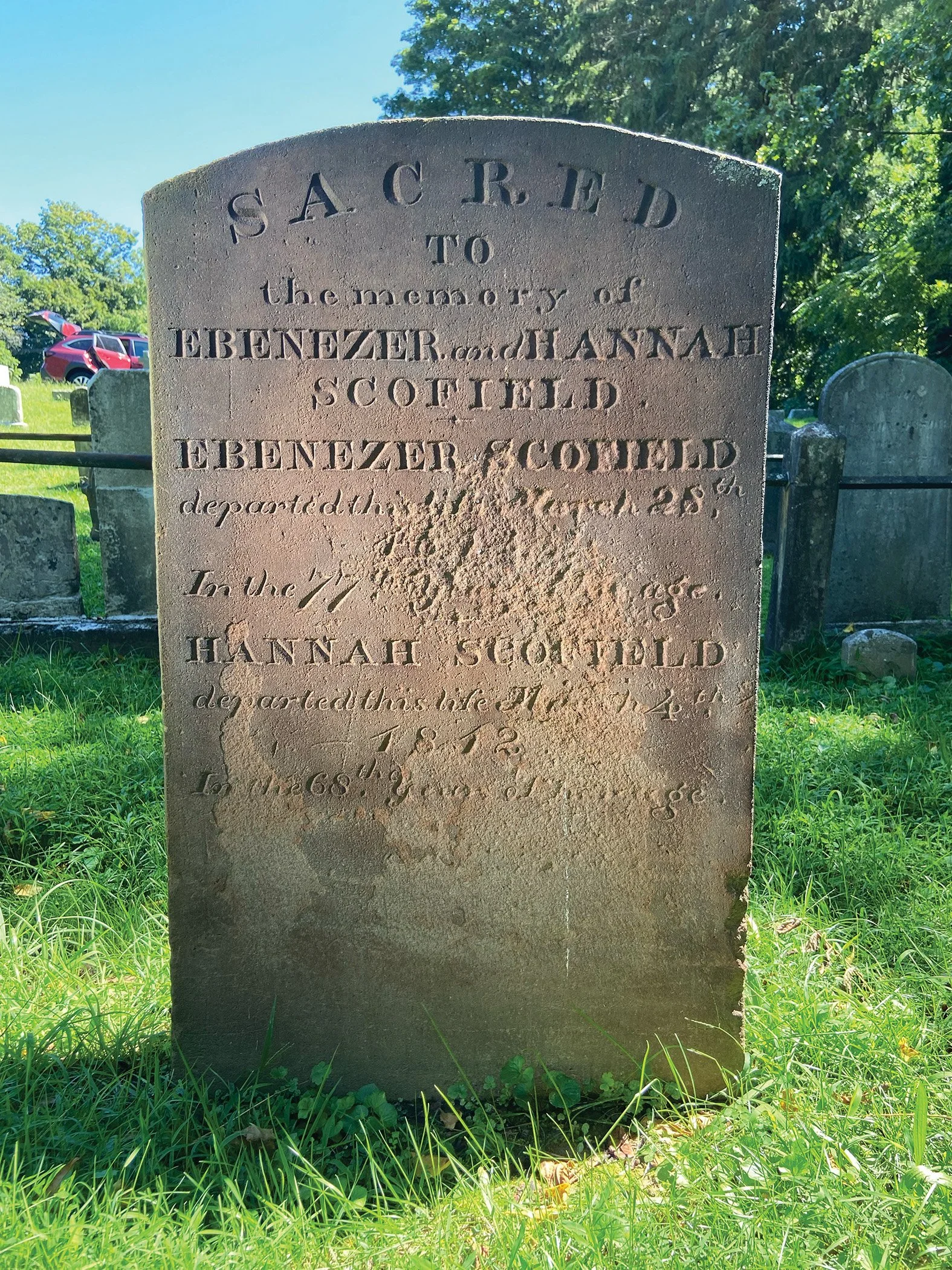
6) Ebenezer Scofield (1736 – 1814)
Lieutenant, Capt. Ebenezer Slason’s First Company of Minute Men, Col. Samuel Drake’s Regiment
Ebenezer Scofield’s story begins with a family already deeply rooted in Pound Ridge. His father, also named Ebenezer Scofield, received a land grant and moved the family there while the younger Ebenezer was still a child. By 1743, the elder Scofield was among Pound Ridge’s early freeholders. The family’s connection to the area would continue for generations.[1]
When the Revolution came, Ebenezer was not the only Scofield to answer the call. His father and brothers also served during the war, making his military service part of a larger family commitment to the Patriot cause.[2]
Scofield himself was chosen for leadership. The Company of Poundridge and Lower Salem, also known as the First Company of Minute Men, elected him Second Lieutenant, and he was shortly afterward promoted to First Lieutenant.[3] Another record identifies him specifically as “Ebenezer Scofield, Junior,” helping to distinguish him from his father, who shared his name. That same source records that commissions for the original officers were issued on October 7, 1775.[4]
His surviving military record places him in Capt. Ebenezer Slason’s First Company of Minute Men under Col. Samuel Drake, serving in Westchester County during 1775 and 1776. The record is clear about his rank: Lieutenant.
One of the most interesting pieces of his military record is the surviving company payroll. It does more than simply confirm that Scofield served. It records 66 days of service and 66 rations due.[5] Those numbers bring us closer to the actual experience behind a name on a Revolutionary War roll. His days were counted, his pay was calculated, and even the rations owed to him were recorded.
There is one complication in following Ebenezer Scofield through the Revolutionary records. His father shared his name and also served, so later references simply naming a “Captain Ebenezer Scofield” cannot always be assigned to father or son with certainty. The record connected to the Ebenezer buried at Sparta, however, identifies him as a Lieutenant. A pension record for Revolutionary veteran Amos Jump shows just how closely these records can overlap. Jump recalled first serving in Capt. Ebenezer Slason’s company under Col. Samuel Drake and, shortly afterward, serving for one month in a company commanded by a Captain Ebenezer Scofield, also under Drake.[6]
What is certain is that the Ebenezer Scofield buried here was selected as an officer during the opening years of the Revolution and served in the local Minute Men under Col. Samuel Drake.
His public service did not end with the war. On April 7, 1789, at the first independent election for town officers, Scofield was elected one of eight Pound Masters.[7] By 1790, the federal census recorded eight people in his household in the Town of Mount Pleasant.[8]
His will gives us an even closer look at the life he built after the Revolution. Scofield identified himself as a farmer of Mount Pleasant and divided his property among his family. His son Elijah received the farm on which he was then living, along with three hundred pounds. His son Ebenezer received part of the farm where Scofield himself lived, including the houses and buildings, with boundaries described by the Sing Sing Road and Tarry Town Road. The heirs of his son Joseph received another portion, while his daughter Hannah Baker received forty acres. His son Samuel received fifty dollars, with Scofield noting that he had already spent considerable sums for Samuel’s education.[9]
The will also preserves the name of someone whose presence might otherwise have disappeared from the record. Scofield named an enslaved Black boy, Jack. He directed that Jack’s services during his remaining period of servitude be used for the benefit of Scofield’s wife, Hannah, if she survived him, and otherwise for the benefit of his surviving heirs.[9]
Ebenezer Scofield died in 1814. His will was proved in Westchester County on September 6 of that year, with testimony that Scofield had signed and declared the document as his last will and testament.[10]
Scofield’s surviving records allow us to follow more than one part of his life. He came from an early Pound Ridge family whose members served the Patriot cause. He was chosen for leadership in the Minute Men, served as a Lieutenant during the opening years of the Revolution, and left behind a payroll recording 66 days of service. After independence, he became part of the new local government and continued his life as a farmer in Mount Pleasant. His will completes that picture, documenting his family, his property, and Jack, the enslaved boy whose name also became part of the record. —JSC
FOOTNOTES:
The Reporter Dispatch (White Plains, NY), April 29, 1995, 31, Newspapers.com.
Revolutionary War service records for the Scofield family, Ancestry.com, as cited in the Revolutionaries at Restresearch database.
Citizen Register (Ossining, NY), February 18, 1970, FultonHistory.com.
Westchester County, New York during the American Revolution, citing Journals of the Provincial Congress: Correspondence, 2:90, accessed through Ancestry.com.
U.S., Revolutionary War Rolls, 1775–1783, database and images, Ancestry.com (Lehi, UT: Ancestry.com Operations, Inc., 2007), company payroll for Capt. Ebenezer Slason’s First Company, Col. Samuel Drake’s Regiment, entry for Ebenezer Scofield.
Amos Jump, Revolutionary War pension claim S. 23284, “United States records,” images, FamilySearch, image 705 of 868; citing National Archives and Records Administration.
FOOTNOTES:
Isaac Delamater, pension declaration, December 5, 1832, Westchester County, New York, Revolutionary War Pension and Bounty-Land Warrant Application Files; affidavits of Tunis Garretson and Samuel Youngs.
Compiled military service record of Isaac Delamater, Hamman’s Regiment, New York Militia; receipt roll for services under Lieutenant Cornelius Vantassel, 1778; Captain Jonas Orser’s Company list; account for service and captivity, 1779–1780.
Isaac Delamater pension certificate, New York, granting pension of $80 per annum, commencing March 4, 1831.
Margaret Delamater, widow’s pension declaration, July 24, 1838, Westchester County, New York.
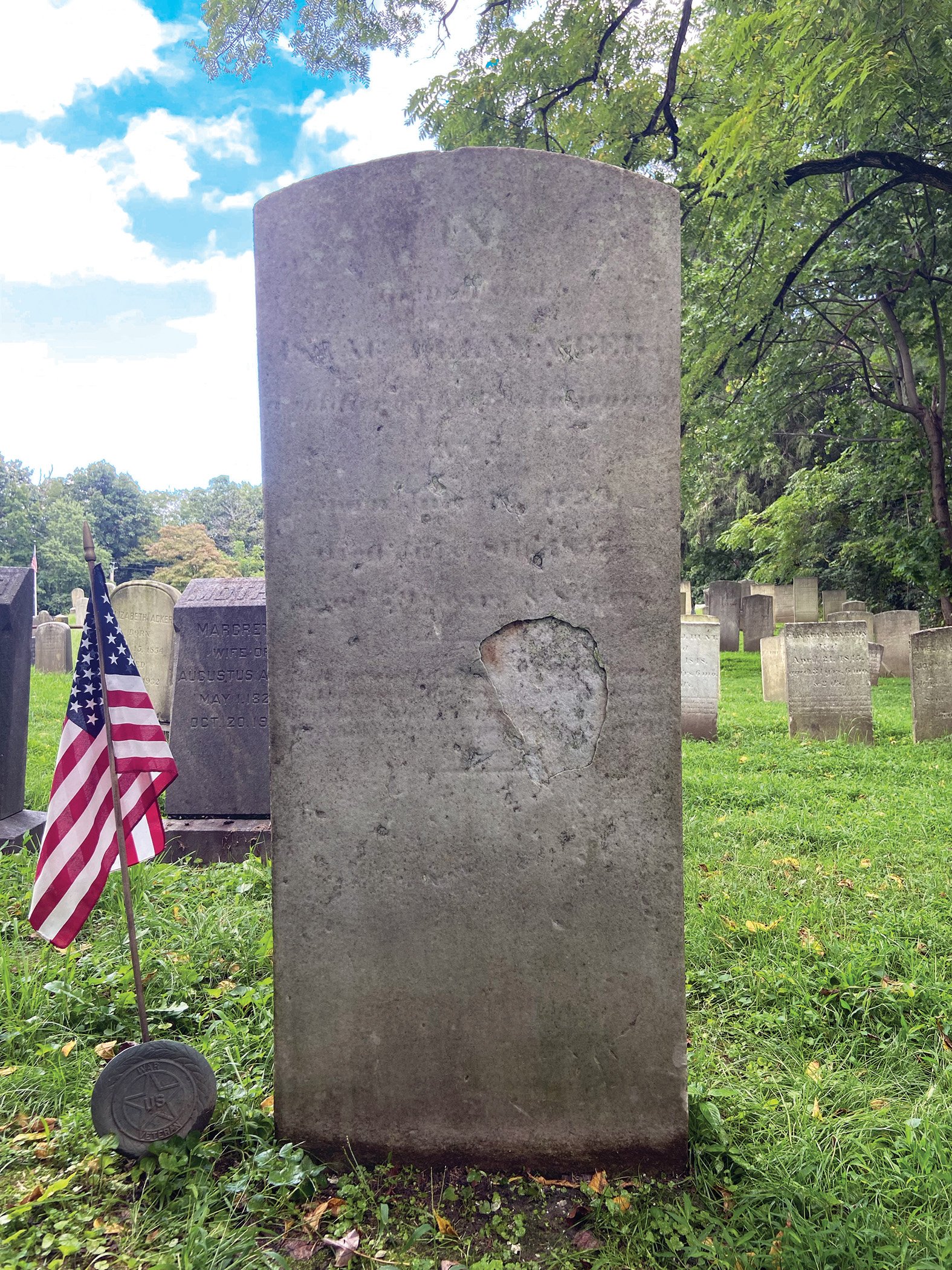
7) isaac delamater (1757 – 1837)
Private, New York Troops and Westchester County Militia
Isaac Delamater’s Revolutionary War service did not take place in one regiment, one location, or during one short enlistment. His surviving pension and military records tell the story of a young man who marched toward Canada, repeatedly returned to duty on the Westchester lines, was captured in his own community, and spent more than a year as a prisoner of the British. His story also intersects with those of other Revolutionary War veterans buried here at Sparta.
Born in 1757 on Philipsburgh Manor, Delamater was living in the Town of Mount Pleasant when the Revolution began. In December 1832, at the age of seventy-five, he appeared before the Westchester County Court of Common Pleas and gave a detailed account of his military service in support of his pension application.¹
Delamater recalled that his first service began in the spring of 1776. While visiting New York City, he volunteered as a private in a company commanded by Captain Walker, in a regiment commanded by Colonel John Stark. He enlisted for nine months and ultimately served about eight.¹
After remaining in New York City for approximately a month, Delamater and the other soldiers boarded a sloop and traveled up the Hudson River to Albany. From there, his journey continued north through Saratoga, Fort Miller, Fort Edward and Lake George. The troops then traveled by boat toward Fort St. John, Chambly and Sorel, carrying this young man from Philipsburgh Manor into the northern campaign toward Canada.¹
Delamater remembered that when the British advanced in superior numbers, the American army was ordered to retreat. He retreated with the army toward Ticonderoga, where he remained for a period before eventually moving back toward Albany. Later that year, his troops traveled south with the intention of joining General Washington’s army in New Jersey. Delamater became ill, however, suffering what his pension record called “bodily indisposition.” After approximately eight months of service, he was honorably discharged.¹
That could have been the end of his Revolutionary War story.
It was not.
By 1777, Delamater was back in service, this time much closer to home with the Westchester County Militia. His pension testimony gives us an interesting glimpse into the way militia service operated. Delamater explained that the men were divided into classes of four and, when a class was called, one of those men was required to serve. The other men in Delamater’s class had families and wanted to remain at home. According to Delamater, each of them paid him ten dollars to perform the service for their class.¹
Delamater served approximately three months as a private under Captain Sylvest Acker, serving on the American lines in Westchester County. At the end of that term, he was honorably discharged near Young’s House. Around December 1777, he volunteered again, this time serving another three months under Captain Gabriel Requa in the Greenburgh area.¹
The surviving military records add another layer to his story. Delamater appears in the records of Hamman’s Regiment of the New York Militia, the name also rendered as Hammond in his pension papers. A receipt roll records payment to Isaac Delamater for military service performed under Lieutenant Cornelius Vantassel in 1778.²
Then came 1779.
In May, Delamater again entered service, this time as a private in Captain Jonas Orser’s Company in the Westchester County militia regiment commanded by Lieutenant Colonel James Hamman/Hammond.¹ ²
Those names create an important connection between Delamater and other men buried at Sparta. Arnold Hunt also served under Captain Jonas Orser and Lieutenant Colonel James Hammond, and Isaac Brown later served under Orser and Hammond as well. These were not isolated Revolutionary stories. The records place several of the men remembered on this tour within the same network of Westchester militia service.
For Delamater, his 1779 enlistment would end very differently from the earlier ones.
On July 1, 1779, he was stationed in Mount Pleasant with five other soldiers when a detachment of British troops captured them. Delamater identified the British commander as Captain Ferguson.¹
The prisoners were taken to Verplanck’s Point, where Delamater remained in British custody for approximately eight days.
Then he was taken to British-occupied New York City.
There, Isaac Delamater was confined in the Sugar House.¹
For a man who had already marched north toward Canada, retreated with the American army, served repeatedly on the Westchester lines and returned again and again to military duty, the war had now become something entirely different. Delamater was no longer a soldier moving from post to post. He was a prisoner.
He remained in the Sugar House for approximately a year. In July 1780, according to his pension declaration, he was transferred to another place of confinement that he identified as the North Church. His imprisonment continued until November 1780, when he was finally exchanged.¹
Once again, we do not have to depend solely upon the memories Delamater recorded more than fifty years after the war. A surviving military account specifically documents his service and captivity. The account was prepared for members of Hamman’s Regiment who were to receive pay from the time they entered service, through the time they were “taken prisoners,” and until they returned from captivity.²
For Isaac Delamater, that record begins his service on May 27, 1779, records his capture on July 1, 1779, and then accounts for the long period he remained a prisoner. The military account carries his captivity through November 1, 1780, while Delamater later remembered that he was exchanged on November 5.¹ ²
His imprisonment also connects his story directly to another veteran buried at Sparta: Isaac Brown. Brown, too, would be captured by the British and imprisoned in the Sugar House. Their individual circumstances were different, but both men from this community experienced British captivity in New York City before eventually returning home.
By the time Delamater applied for his pension in 1832, more than half a century had passed since the Revolution. He stated that he no longer had documentary evidence of all of his periods of service. His case therefore depended partly upon his own recollections and upon the testimony of men who knew him.
Tunis Garretson testified that he knew Delamater and corroborated portions of his militia service, including service under Captain Acker. Garretson and Samuel Youngs also testified that Delamater was known in his community as a soldier of the Revolution.¹
Delamater’s pension was approved at $80 per year.³
Isaac Delamater died on July 8, 1837. The following year, his widow, Margaret Delamater, appeared before the court seeking benefits based upon her husband’s Revolutionary War service. She stated that she and Isaac had married on December 24, 1785, at her father’s house in Mount Pleasant, with James Requa, then a justice of the peace, performing the marriage. Her declaration also repeated important parts of the military story Isaac had left behind: his service beginning in 1776, his march toward Canada, and his later service in the Westchester militia.⁴
Isaac Delamater’s story shows just how long and varied Revolutionary War service could be for a man living in Westchester County. He first left home as a young volunteer and traveled north toward Canada. He came back and returned to service again and again on the American lines closer to home. He served under officers whose names appear in the military histories of other men buried here at Sparta. And finally, while stationed in Mount Pleasant, the war found him at home.
On July 1, 1779, he was taken prisoner in the very community he was serving to defend.
He would not return from British captivity for more than a year. —JSC
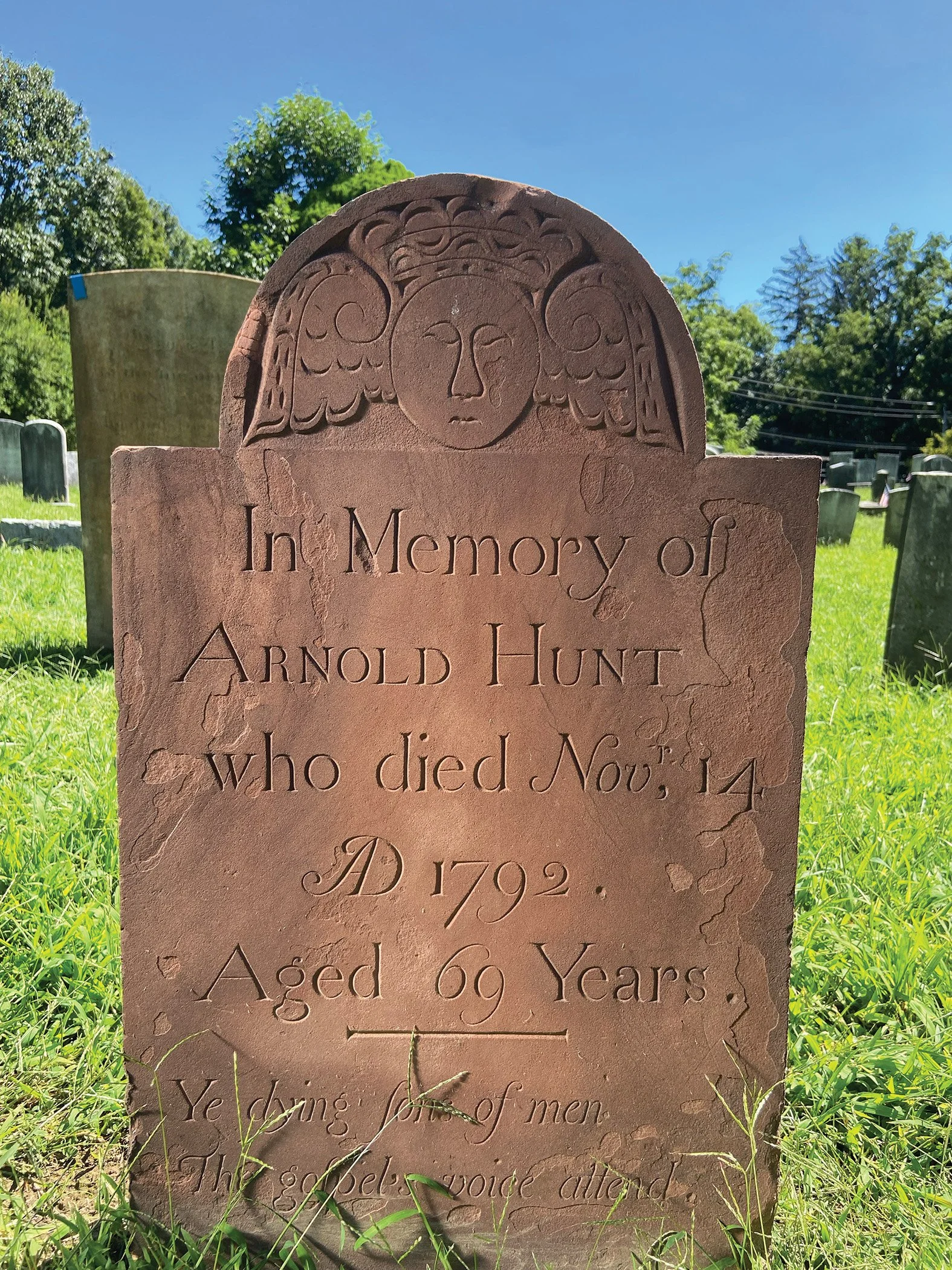
8) arnold hunt (c. 1723 – 1792)
Private, First Regiment, Westchester County Militia
Arnold Hunt was born in Tarrytown in 1723 and became a farmer in the Upper Manor of Philipsburgh. His farm extended along Scarborough Road in Sparta, and the Hunt house once stood near the present location of the Scarborough firehouse.
During the Revolutionary War, Hunt served as a private in the First Regiment of the Westchester County Militia under Col. Joseph Drake, Lt. Col. James Hammond, and Capt. Jonas Orser. His name appears on New York State’s list of enlisted men, preserving a record of his service in the struggle for independence.[1]
One of the most compelling stories about Hunt’s wartime experience has been preserved through family lore.
While home on a brief furlough during the Revolutionary War, Hunt’s arrival was reported by a Tory neighbor. Some British men in the neighborhood, believing that he had money with him, came to his house and demanded that he surrender it. When Hunt refused, they hanged him beneath an apple tree.
They left him hanging there for a time and then departed, believing he was dead. As soon as they were gone, Hunt’s wife cut the rope. With help, she was able to revive him.
Once Hunt recovered his strength, he returned to his regiment and continued fighting until the close of the war.
What his attackers never knew was that, only a short time before they arrived and demanded his money, Hunt had buried an iron box containing $300 beneath that identical apple tree.
According to the family account, the knife used to cut Hunt down remained in the possession of his descendant, Miss Helena M. Foster, who was living in Arizona when she shared this reflection.[2]
After the Revolution, the confiscated estate of Frederick Philipse III was sold by New York State. In 1785, Hunt purchased the farm he had formerly tenanted from the Commissioners of Forfeitures. Identified as farm number five, the property was sold to “Arnold Hunt of the County of Westchester, farmer,” for £849.[3]
The First Presbyterian Church, built in 1768, and its burial ground stood in the midst of the Hunt farm. However, the church, meetinghouse, and two adjoining acres were specifically reserved from Hunt’s purchase.[3] This is an important distinction. Although local lore later credited Hunt with donating the land for Sparta Cemetery, the property was not his to donate because it had been excluded from the sale.
Hunt eventually held 283 acres, making him the largest landowner in the Sing Sing territory of the Upper Manor.[4] The 1790 federal census recorded four people in his Mount Pleasant household: one free white male aged sixteen or older and three free white females.[5]
On October 31, 1788, Hunt prepared his last will and testament. Describing himself as weak in body but of sound and perfect memory, he first directed that his debts be paid. He then made provisions for his beloved wife, Phebe, and their two sons, Ichabod and Stephen.[6]
Phebe was to receive the use of one-half of the farm for as long as she remained Hunt’s widow. She was also to receive one-third of his movable estate and the use of the homestead. If she died or remarried, the homestead would pass to their son Stephen. The remainder of Hunt’s real and personal property was to be divided equally between Ichabod and Stephen. Following their mother’s death or remarriage, all of Hunt’s land was to be divided between the two sons.[6]
Hunt appointed Phebe as executrix and his trusted friend John Bishop as executor. His will was witnessed by Andrew Lester, Jane Lambert, and Daniel Miller.[6]
Arnold Hunt died in Mount Pleasant on November 14, 1792, at the age of sixty-nine. His will was proved on May 29, 1793.[6] He rests here in Sparta Cemetery, the burial ground that once stood in the midst of his farm but was never included among the lands he owned. —JSC
FOOTNOTES:
James A. Roberts, comp., New York in the Revolution as Colony and State (Albany, NY: Weed-Parsons Printing Company, 1897), First Regiment, Westchester County Militia.
Helena M. Foster, family reflection concerning Arnold Hunt, undated.
New York State Commissioners of Forfeitures, “Sale of Farm No. 5 to Arnold Hunt,” 1785, Westchester County Archives Digital Collections, accessed September 4, 2026, https://collections.westchestergov.com/digital/collection/forfeiture/id/88/rec/1.
Citizen Register (Ossining, NY), January 17, 1933.
1790 U.S. census, Mount Pleasant, Westchester County, New York, 168–69.
Arnold Hunt, last will and testament, October 31, 1788, proved May 29, 1793.
FOOTNOTES:
Grenville C. Mackenzie, Families of the Colonial Town of Philipsburgh, Part One (Westport, CT, 1966; bound by Sleepy Hollow Restorations, Tarrytown, NY, 1976), Abraham Ladew entry, Westchester County Historical Society.
Ancestry.com, U.S., Revolutionary War Rolls, 1775–1783 (Lehi, UT: Ancestry.com Operations, Inc., 2007), returns and officer lists for Capt. Abraham Ledew’s Company, Thomas’ Regiment, New York Militia, September 26, October 3, October 4, October 31, November 7, November 14, and November 21, 1776.
Stephen Van Tassel, Revolutionary War pension testimony, testimony concerning service under Capt. Abraham Ladew and the Battle of White Plains.
Commissioners of Forfeitures, record concerning Abraham Ladew’s property, 1786, Westchester County Archives Digital Collections, record 57.
“Original Town Officials,” Citizen Register (Ossining, NY), February 18, 1970, Fulton History.
Citizen Register (Ossining, NY), August 30, 1934, Fulton History.
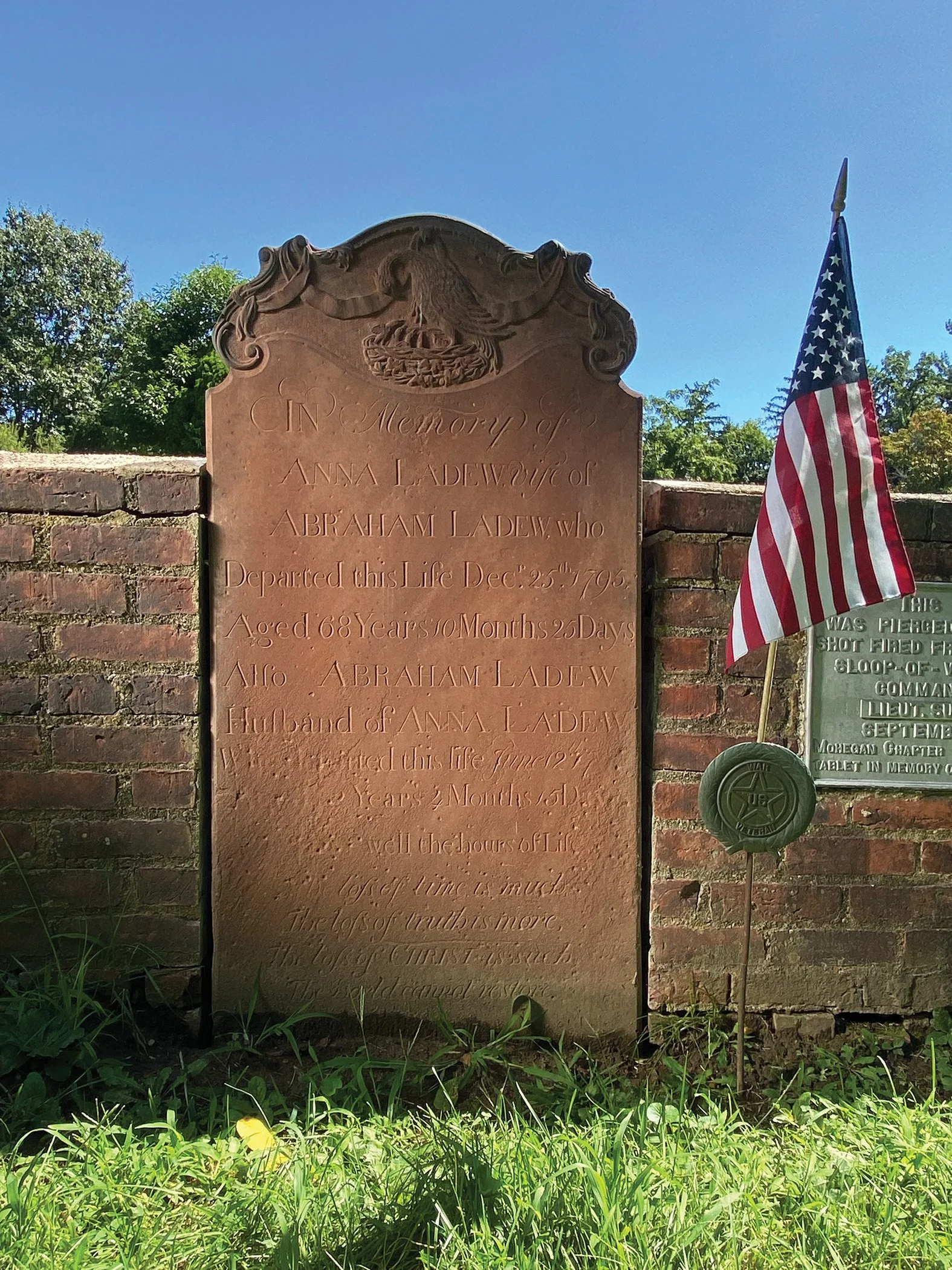
9) abraham Ladew (1727 – 1799)
Captain, Upper Philipsburgh Company of the Westchester County Militia
Abraham Ladew’s story is one that becomes more interesting the deeper we look into the surviving records. He was not simply a name on a Revolutionary War roster. The records allow us to see him as a militia captain trying to keep a company together during the difficult fall of 1776, while pension testimony from one of the men who served under him places his company at the Battle of White Plains.
Born in New Rochelle in 1727, Ladew came from a French Huguenot family with early roots in New Rochelle. He was the son of Daniel and Mary Ladew. His name appears in the records in several forms, including Ladew, Ledew, Ladue, and LeDoux. He later made his home on Philipsburgh Manor, where he was a farmer and blacksmith.[1]
When the Revolution began, Ladew became a local Patriot leader. He was commissioned captain of the Upper Philipsburgh Company of the Westchester County Militia in 1775 and remained in command through 1778.[1] Surviving military records from 1776 also document Captain Abraham Ledew’s Company in Colonel Thomas Thomas’s Regiment of the New York Militia.[2]
Those records give us something more than his rank. They give us a glimpse inside his company.
On September 26, 1776, Ladew’s company reported twenty-six rank-and-file men present and fit for duty and another three sick. Yet the company was still twenty-four privates short, and three men had deserted since the previous return.[2]
Ladew himself was sick that day—but he had not gone home.
The return records him as “Capt. Ledew sick present.” His second lieutenant was sick and absent, while his first lieutenant was away serving in the artillery. One of the men who had been counted as fit for duty was being held under guard.[2]
A week later, on October 3, the company included three sergeants, two drummers and a fifer. Twenty-one rank-and-file men were fit for duty, one was sick, and four desertions had been recorded since the previous return.[2]
The following day, October 4, Ladew himself was recorded as “present fit for duty.”[2]
These weekly returns show just how quickly the condition of his company could change.
By October 31, only six rank-and-file men were listed as present and fit for duty. Two were sick but present, four were sick and absent, four were away on command, and five were on furlough. The company was twenty-five privates short. Once again, Ladew was recorded as sick but present.[2]
His first lieutenant continued to serve in the artillery, while his second lieutenant had been left at Fort Independence.
And then there is one of my favorite details in these records because it reminds us that these were real men, not simply numbers on a page.
The return reported eight deserters in all—including the drummer.[2]
Only a few weeks earlier, Ladew had two drummers and a fifer in his company. Now one of his drummers was among the men who had left.
On November 7, eleven rank-and-file men were fit for duty. One was sick and present, five were sick and absent, and four were away on command. Ladew’s second lieutenant, a sergeant, and four men had been left at Fort Independence, while his first lieutenant remained with the artillery. The return continued to record eight deserters, including the drummer.[2]
By November 14, thirteen men were fit for duty. Two were sick and present, five were sick and absent, one was on command, and another was on furlough. A drummer again appeared on the company return. The fifer was now among those listed sick and absent without leave.[2]
Then comes the return of November 21, 1776, from Peekskill.
Ladew and his second lieutenant were present. Twenty-one rank-and-file men were fit for duty, and another man was on command. A sergeant and drummer were also recorded with the company.
But the number of deserters had increased.
The return recorded ten deserters in all—including two sergeants and the fifer.[2]
This is what makes Ladew’s surviving military records so compelling. They allow us to see what the title Captainactually meant. His company was constantly changing. Men were sick. Men were sent elsewhere. Some were on furlough. His officers were assigned to other duties. Some men deserted. Even the drummer and fifer became part of that story.
And Ladew himself appears twice in those returns as sick, but present.
There is another important piece of his military story.
The Revolutionary War pension testimony of Stephen Van Tassel, who served under Ladew, places Ladew’s company at the Battle of White Plains in October 1776.[3] That testimony connects these weekly military returns to one of the significant moments of Ladew’s wartime service. We know from the returns what was happening within his company during those weeks, and Van Tassel’s testimony tells us that men serving under Ladew were at White Plains.
Ladew’s Patriot service was not limited to the militia. In 1777, he also served on the Committee of Safety, extending his role beyond military command into the local revolutionary government.[1]
When the war was over, Ladew continued to build his life in the community he had helped defend.
He had lived on Philipsburgh Manor as a tenant. In 1786, he purchased the farm he had occupied through the Commissioners of Forfeitures.[4]
He also continued in public service. In the early government of the Town of Mount Pleasant, Ladew served as Overseer of the Poor and Fence Viewer.[5][6] The captain who had commanded local militia during the Revolution became one of the men helping govern the community after independence.
His story also becomes deeply personal here at Sparta Cemetery.
Abraham and his wife Anna lost both of their children young. Their daughter Sarah, born in 1759, died in 1764. Their son Abraham, born in 1769, died in 1774.[1] A 1934 account identified Sarah Ladew’s gravestone as possibly the earliest surviving stone in Sparta Cemetery.[6]
Anna died in 1795. Abraham Ladew died on June 12, 1799, at the age of seventy-two.[1]
But Ladew had thought about what would happen to his family burial place after he was gone.
His will provided for a stone enclosure around the Ladew family burial plot and for its continued care and maintenance.[6] That makes the enclosure here more than simply part of the cemetery landscape. It is part of Abraham Ladew’s story and one of the things he deliberately left behind.
There is also a mystery within the family plot.
The gravestone of young Abraham Ladew Jr. contains a hole that became the subject of local lore. The traditional story connected the damage to the British sloop of war Vulture and the events surrounding Benedict Arnold and Major John André in 1780.[6] The story has survived, even as questions have been raised about whether the evidence supports it.
What is not in doubt is the documented story that surrounds the stone.
Here rests a man descended from an early French Huguenot family in New Rochelle who became a farmer and blacksmith on Philipsburgh Manor, a captain in the local militia, a member of the Committee of Safety, a landowner, and a public official.
And unlike so many Revolutionary War veterans for whom only a name and rank survive, Abraham Ladew left us something more.
His military returns allow us to follow his company week by week: the sick, the men on command, the men on furlough, the drummers, the fifer, and the deserters. Stephen Van Tassel’s pension testimony places men serving under him at the Battle of White Plains.
Those records bring Captain Abraham Ladew out of the pages of a military roster and place him back among the men he commanded during the Revolution. —JSC
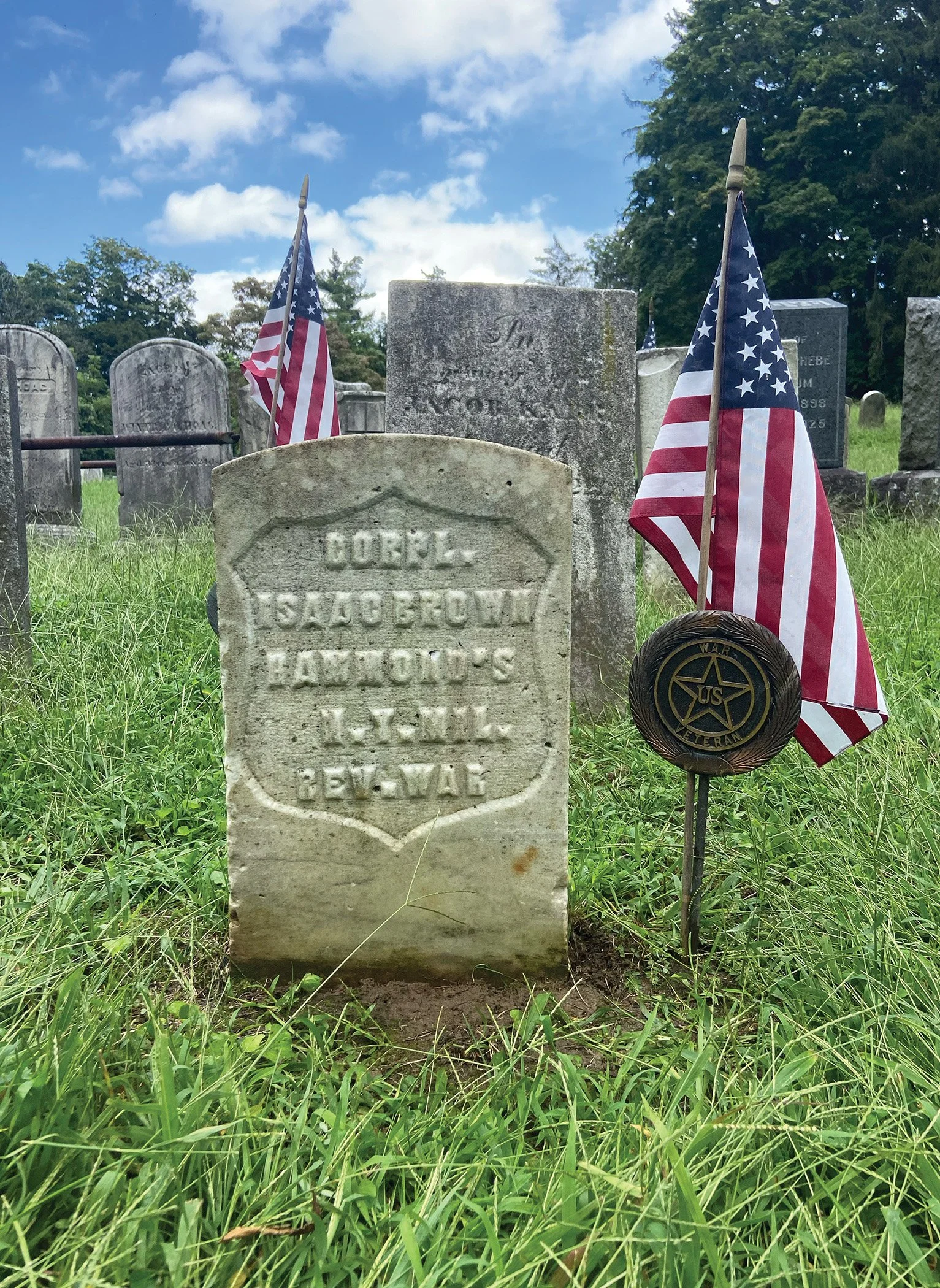
10) isaac Brown (c. 1757 – 1838)
Private, New York Militia
Isaac Brown was born about 1757 in Fordham, then part of Westchester County. His Revolutionary War story is especially compelling because so much of his service took place in the county where he was born and would later make his home.
Brown first entered service in August 1776 as a Private in the New York Militia under Capt. Abraham Ladew, another Revolutionary War veteran buried here at Sparta Cemetery. He enlisted for a five-month term and was marched to Fort Independence. After serving about a month and a half, Brown hired a substitute to complete the remainder of his term. His pension record does not identify the man who served in his place.[2]
Brown returned to service in April 1778, this time for a full year. He was stationed at King’s Ferry at Verplanck’s Point, an important Hudson River crossing, where he was assigned to serve as a military ferryman. Brown made clear in his pension declaration that this was military duty: he received the rations, clothing, and pay of a soldier while serving at the ferry.[3]
More than fifty years later, William Lambert, who had known Brown during the Revolution, came forward to support his pension claim. Lambert testified that he frequently saw Brown at King’s Ferry during that year, remembered him serving as a ferryman, and confirmed that Brown completed his term and was honorably discharged.[4]
In May 1779, Brown returned to the militia again. He served in Capt. Jonas Orser’s company under Lt. Col. James Hammond, whose regiment served on the Westchester lines.[5] These officers also appear in the stories of other veterans buried at Sparta. Arnold Hunt served under Orser and Hammond, and Isaac Delamater also served under them during the Revolution. These overlapping records show how closely connected the men on this tour were through both place and military service.[6]
In April 1780, Brown’s service took a dramatic turn.
While his company was quartered at Philipsburg Manor in Westchester County, British troops captured him. Among the men serving with him was Benjamin Brown, an ensign in the same company and Isaac’s brother.
The brothers were captured at the same time.
During the capture, Isaac was wounded in the head. The British began taking him away with the other prisoners, but his wound left him unable to continue. Benjamin later testified under oath that after carrying Isaac some distance, the British realized that he could go no farther because of his injury and released him on parole.[7]
Parole did not mean that Brown was free. During the Revolutionary War, a paroled prisoner remained a prisoner of war, although he was no longer being physically confined. He remained bound by the conditions of his parole until formally exchanged.
According to Benjamin, Isaac remained a prisoner on parole until about March 1781. The British then took him into custody again and carried him to New York City.
Brown stated in his pension application that he was confined in the Sugar House, one of the locations used by the British to hold American prisoners during the Revolution. He remained there for approximately a month and a half before he was finally released through a prisoner exchange.[8]
This creates another connection between the veterans on this tour. Isaac Delamater was also captured by the British in Westchester County and later imprisoned in the Sugar House. Their experiences show the danger faced by local militia serving in the contested landscape of Revolutionary Westchester.[9]
One of the strongest parts of Brown’s pension file is the testimony of the men who remembered his service more than fifty years later.
William Lambert remembered seeing him serving at King’s Ferry. Martin Brown and Gabriel Sherwood testified that Isaac was known in the Mount Pleasant community as a Revolutionary War soldier. Judge Edward Hennessey, after reviewing Brown’s claim, stated that he believed Brown “was a Revolutionary soldier and served as he states.”[10]
Most important was the testimony of Isaac’s brother Benjamin. Benjamin was not repeating a family story that had been handed down over the years. He had been there. He had served with Isaac, had been captured with him, and had personally witnessed the wound that left his brother unable to continue with their British captors.[11]
The federal government accepted Brown’s claim. In 1832, he was placed on the New York pension roll as a Private and credited with two years and two months of Revolutionary War service. His pension was set at $80 per year.[12]
After the war, Brown returned to civilian life in Westchester County. In 1784, he married into the Shute family, and family records identify eight children. Brown worked as a farmer. The Brown family farm was located along Bedford Road near what is today Pocantico Hills, keeping him rooted in the same Westchester landscape where much of his Revolutionary service had taken place.[13]
Brown lived for more than fifty years after the Revolution. Near the end of his life, he was living with his daughter Ann and her husband, Noah Secor. His probate records provide a final glimpse into the family life he built after the war: following his death in 1838, relatives and friends gathered in the house as his final wishes were read aloud.[14]
Brown’s gravestone at Sparta carries an inscription that speaks directly to those who pass it:
“Behold and see, as you pass by,
As you are now, so once was I,
As I am now, so must you be,
Prepare for death and follow me.”[15]
Isaac Brown’s story is not simply the story of one soldier. His life connects several of the men buried here. He served under Abraham Ladew, served under officers connected to Arnold Hunt and Isaac Delamater, was captured alongside his own brother, survived imprisonment, and returned home to farm and raise his family.
His story also reminds us that the Revolution was not happening somewhere far away. For Isaac Brown, the war came through the roads, farms, river crossings, and communities of Westchester County—and after the war, he returned to those same places to build the rest of his life. —JSC
FOOTNOTES:
Isaac Brown, pension declaration, November 28, 1832, U.S., Revolutionary War Pension and Bounty-Land Warrant Application Files, 1800–1900, Ancestry.com (Provo, UT: Ancestry.com Operations, Inc., 2010).
Brown, pension declaration, November 28, 1832; Benjamin Brown affidavit, August 24, 1832, Isaac Brown pension file.
Brown, pension declaration, November 28, 1832.
William Lambert affidavit, August 24, 1832, Isaac Brown pension file.
Benjamin Brown affidavit, August 24, 1832, Isaac Brown pension file.
Arnold Hunt military service record, Daughters of the American Revolution, FamilySearch, image 2048 of 5350; Isaac Delamater pension application, U.S., Revolutionary War Pension and Bounty-Land Warrant Application Files, 1800–1900, Ancestry.com.
Benjamin Brown affidavit, August 24, 1832, Isaac Brown pension file.
Isaac Brown, pension declaration, November 28, 1832; Benjamin Brown affidavit, August 24, 1832, Isaac Brown pension file.
Isaac Delamater pension application, U.S., Revolutionary War Pension and Bounty-Land Warrant Application Files, 1800–1900, Ancestry.com.
William Lambert affidavit, August 24, 1832; Martin Brown and Gabriel Sherwood affidavit and Edward Hennessey certification, November 28, 1832, Isaac Brown pension file.
Benjamin Brown affidavit, August 24, 1832, Isaac Brown pension file.
Isaac Brown pension award, U.S., Revolutionary War Pension and Bounty-Land Warrant Application Files, 1800–1900, Ancestry.com (Provo, UT: Ancestry.com Operations, Inc., 2010).
“Isaac Brown and Anna Shute,” Tarrytown 3, Book 52A, Holland Society of New York, in U.S., Dutch Reformed Church Records in Selected States, 1639–1989, Ancestry.com (Lehi, UT: Ancestry.com Operations, Inc., 2014); Westchester County Commissioners of Forfeiture records relating to the Brown family property, 1785, Westchester County Archives Digital Collections.
Westchester County (N.Y.), Surrogate’s Court, will and probate proceedings of Isaac Brown, New York, U.S., Wills and Probate Records, 1659–1999, Ancestry.com (Lehi, UT: Ancestry.com Operations, Inc., 2015).
“Old Cemetery Has Stones With Elaborate Inscriptions,” Citizen-Register (Ossining, NY), August 31, 1934.
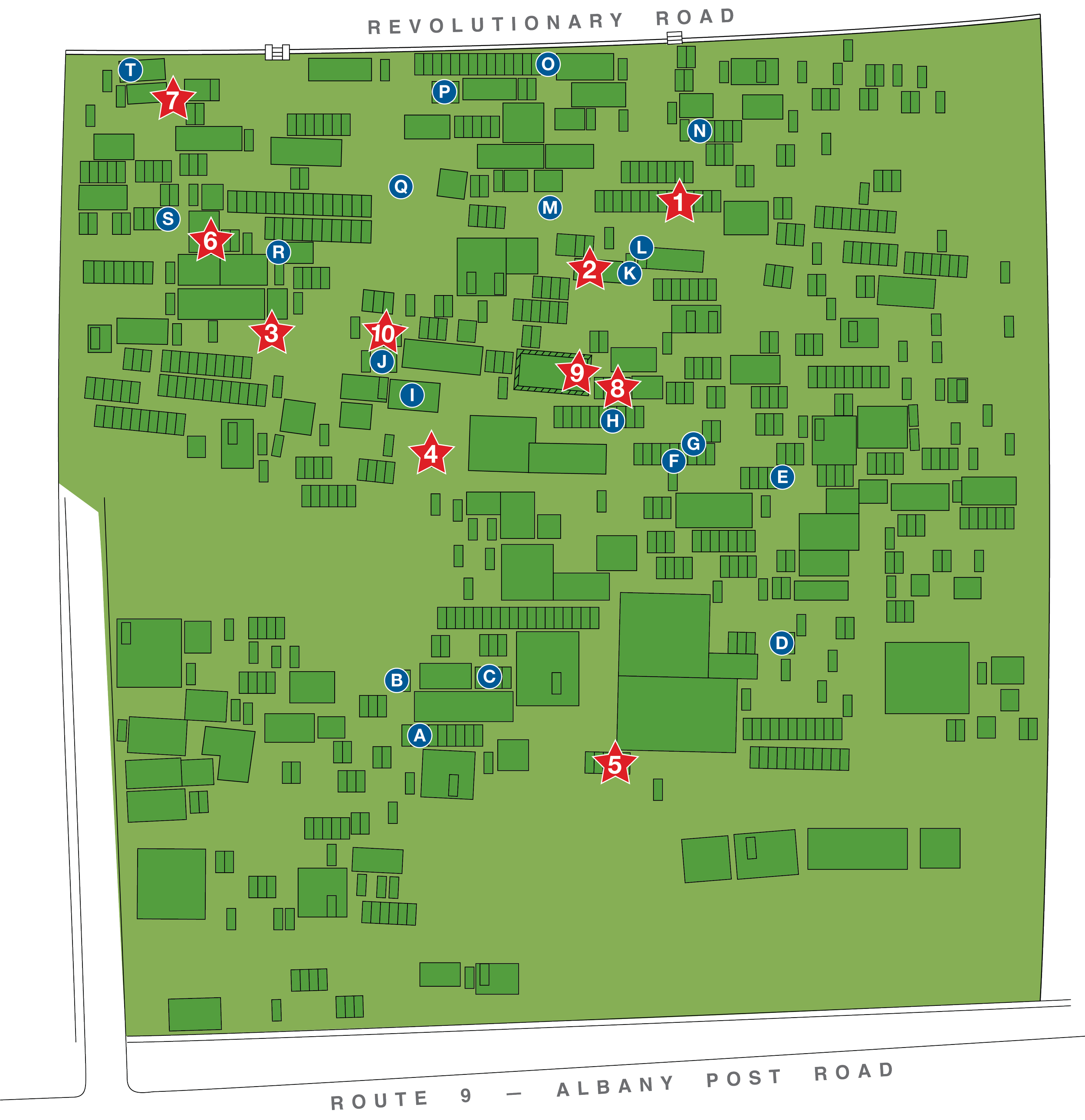
Other Revolutionary Veterans buried at Sparta Cemetery:
A) Samuel Miller
B) Abraham Merritt
C) Lewis Miller
D) Gersham Sherwood
E) James Minnerly
F) Daniel Miller
G) Caleb Smith
H) John Oakley
I) John Orser
J) Jacob Karr
K) Samuel Merrit
L) William Miller
M) Job Sherwood
N) Thomas Ward, Jr.
O) Thaddeus Sarlls
p) Michael Ogden
Q) John Rossel
R) Nicholas Brower
S) Phillip Acker
T) Ezekiel Shute
John Garrison and Abraham Ressegiue, like Nathaniel Garrison, are included in previous Sparta Cemetery Veterans lists but their stones have not been located.